




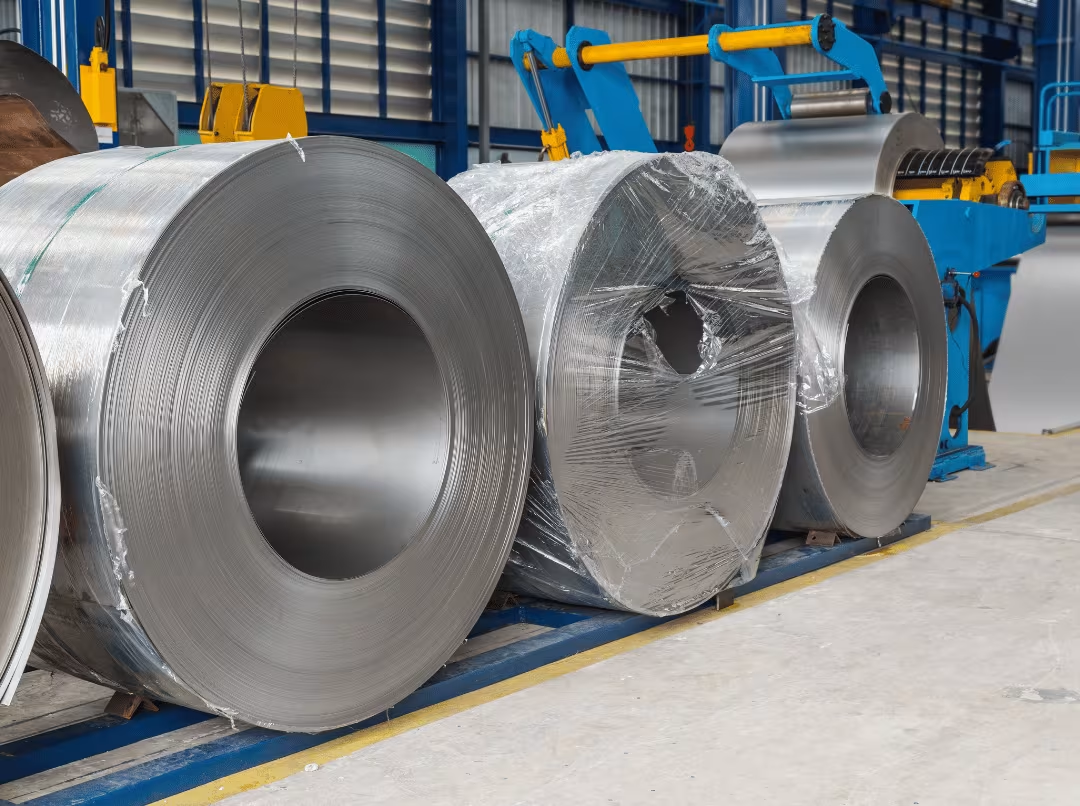
The same gauge number trips up buyers every day. One supplier says “20 gauge.” The next quotes “0.036 inches.” Then a datasheet buries a G90 spec three lines down in fine print, and suddenly you’re not sure you’re even comparing the same material.
Guess wrong, and you land in one of two bad spots. Either the steel is too thin for the load, or you’ve paid for stock far heavier and pricier than the job ever called for.
This guide ends that guessing. You’ll get straight answers to the three questions that actually decide your order:
- How thick is a given gauge, in inches and millimeters?
- How much does it weigh, per square foot and per full sheet?
- Which gauge should you pick for your specific project?
We lead with the chart. Then we cover how to read it without getting burned, how to size gauge by application, and how to run the weight before you buy.
Quick answer: For galvanized steel, a lower gauge number means thicker steel. 16 gauge is about 0.0635 in (1.613 mm). 24 gauge is about 0.0276 in (0.701 mm). The gauge measures the base steel only — the zinc coating (G60, G90) is a separate spec that controls rust resistance, not thickness.
Galvanized Steel Gauge Chart: Quick Reference Table
Here’s what most people came for. These are the gauges you’ll actually work with, listed in decimal inches and millimeters.
|
Gauge |
Thickness (inches) |
Thickness (mm) |
|---|---|---|
|
10 |
0.1382 |
3.510 |
|
12 |
0.1084 |
2.753 |
|
14 |
0.0785 |
1.994 |
|
16 |
0.0635 |
1.613 |
|
18 |
0.0516 |
1.311 |
|
20 |
0.0396 |
1.006 |
|
22 |
0.0336 |
0.853 |
|
24 |
0.0276 |
0.701 |
|
26 |
0.0217 |
0.551 |
|
28 |
0.0187 |
0.475 |
|
30 |
0.0157 |
0.399 |
Three things before you lean on these numbers:
- These values follow the US Standard Gauge for galvanized (hot-dip zinc-coated) steel. That standard already accounts for a small coating allowance in the listed thickness, so galvanized figures are slightly higher than those for bare cold-rolled steel at the same gauge.
- The gauge number refers to the base steel thickness. The zinc coating sits on top and gets specified separately.
- Datasheets usually print both the gauge number and the decimal thickness. When the two don’t match your expectation, trust the decimal and ask which standard the supplier used.
Use this table as your starting point, not the whole story. The rest of this guide shows you how to apply these numbers without a costly slip.
What Gauge Actually Means for Galvanized Steel
Here’s the rule that catches people out: a lower gauge number means thicker steel. A 10-gauge sheet is about 9 times thicker than a 30-gauge sheet. So kill the instinct that a bigger number equals stronger material. It’s backward.
The second point matters just as much. Gauge measures the base steel underneath — not the galvanized layer on top. Order 16 gauge galvanized steel and you’re specifying the thickness of the steel itself. The zinc adds a thin, measurable skin over that, but it never counts toward the gauge.
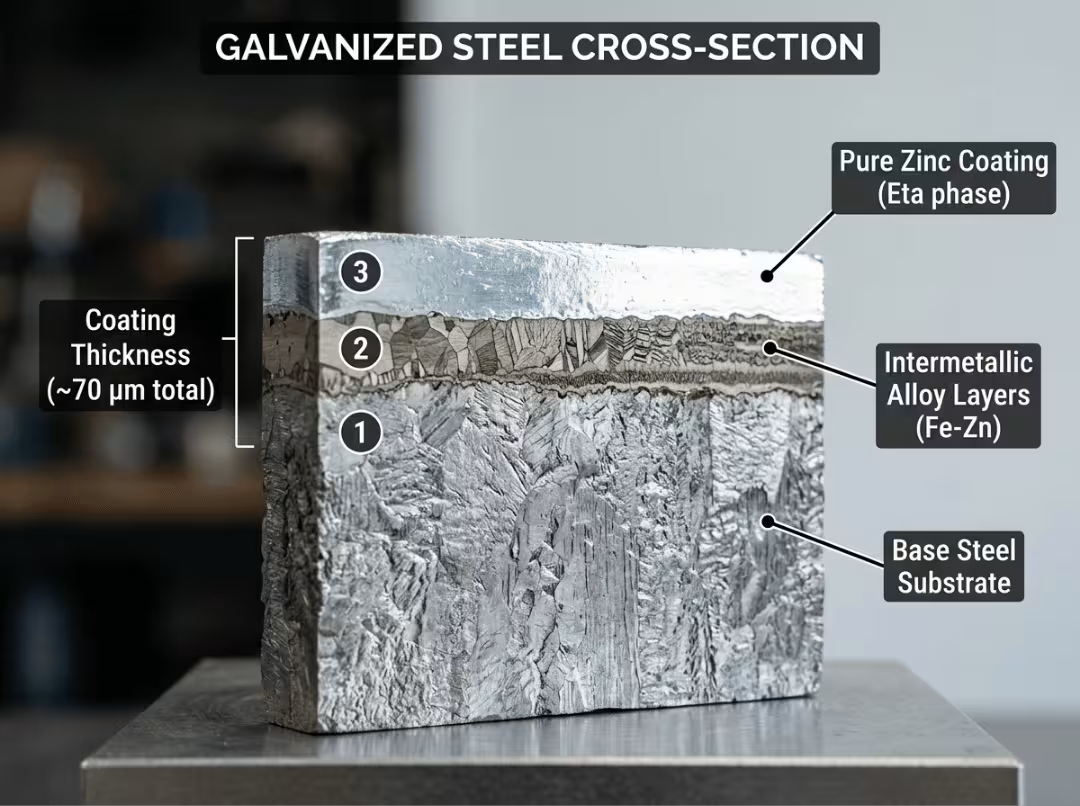
That coating gets its own spec: the coating class, written as G60, G90, and so on. The number tells you how much zinc protects the sheet, measured in ounces per square foot across both faces. G90 carries about 0.90 oz/ft². G60 carries about 0.60 oz/ft². More zinc buys better corrosion resistance. It does not buy structural thickness.
So two specs always run in parallel, and they answer different questions:
- Gauge → how thick and strong is the steel?
- Coating class → how long will it fight rust?
Blur them together, and you order the wrong material. Keep them apart, and you’re already ahead of most buyers.
How to Read a Galvanized Steel Gauge Chart Correctly
Once the inverse relationship clicks, the chart reads easily. Picture the spread. 26-gauge is a thin, bendable roofing material you can flex by hand. 10-gauge is heavy structural stock that requires specialized equipment to form. Everything else sits between those two poles.
Try a real example. Your drawing calls for 14 gauge. Move across the chart, and you land on roughly 0.0785 inches, or 1.994 mm. Need 16 gauge instead? That’s about 0.0635 inches, or 1.613 mm. That’s the whole move — a spec on paper turned into a dimension you can measure.
But the chart value is nominal, not a promise. Coil tolerances mean the actual material can run a few thousandths of an inch on either side of the listed number. On a light gauge, that drift can nudge your weight math and even change how a part fits. When precision counts, use a micrometer on the actual coil rather than trusting the nominal figure.

Mapping decimal back to gauge. Suppliers often quote a decimal — “0.060 inches” — instead of a gauge number. To translate, find the nearest chart value and accept that it’s rarely a clean match. A quoted 0.060 in sits between 16 and 18 gauge, leaning toward 16. When it does, ask which gauge standard the supplier follows so you’re comparing like with like.
One last flag before you order: gauge alone is not a complete spec. You still need to state the coating class and confirm the thickness tolerance. Order by gauge only and you’ve left two important variables to chance.
Galvanized Steel Gauge by Application: What to Choose and Why
This is where data becomes a decision. Knowing 24 gauge equals 0.0276 inches is handy. The real question is whether 24 gauge suits your job. Below are the four applications in which choice matters most, each with the reasoning behind its range.
Roofing
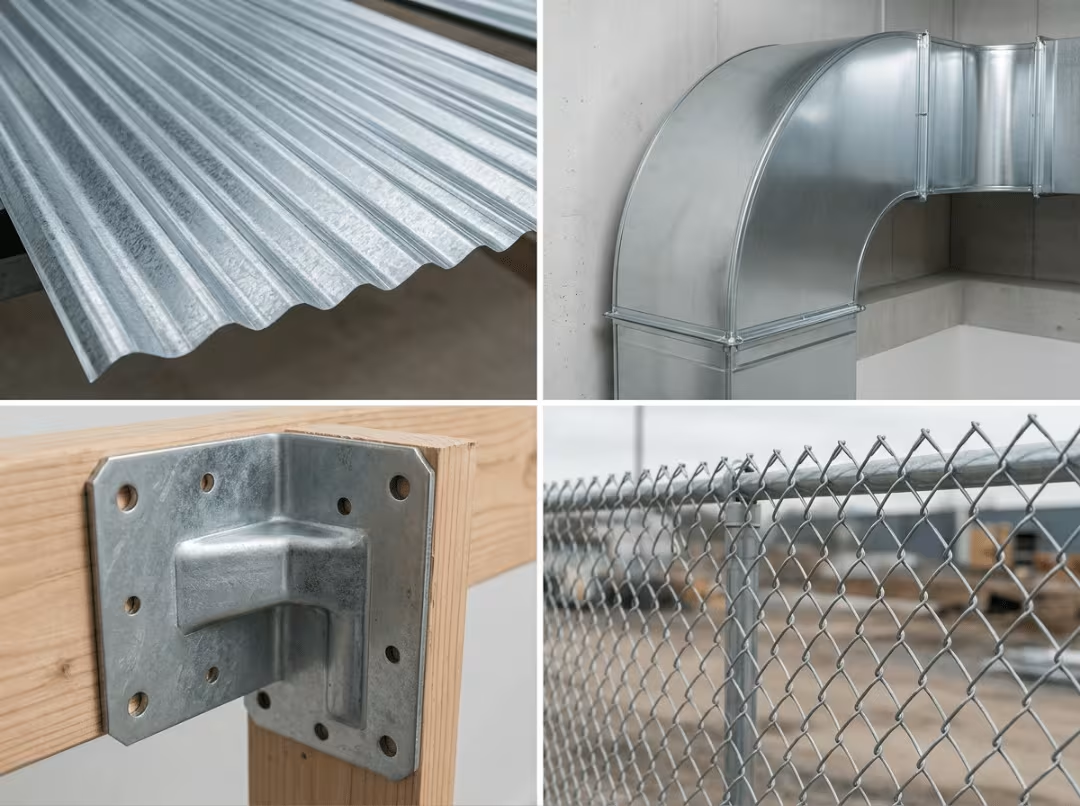
Residential metal roofing usually runs 26 gauge. Commercial roofing steps up to 24 gauge. The heavier commercial pick handles longer spans, shrugs off foot traffic during maintenance, and holds up better against wind uplift on big surfaces.
Use 26 gauge on a standard home roof, and you’re fine. But it turns too thin once panels stretch long, wind loads climb, or people walk the surface regularly — it can oil-can (ripple) or dent. That’s when 24 gauge earns its price.
For roofing, coating class matters as much as thickness. A roof lives outdoors in constant weather, so pair your gauge with at least a G90 coating for real corrosion life. Skimp on the zinc and even thick steel rusts early at cut edges and fasteners.
HVAC Ductwork
Light residential ductwork commonly uses 24- to 26-gauge. As duct dimensions increase, larger commercial systems shift to 20- or 22-gauge to resist deformation and vibration.
Cross-section and pressure drive the call here. A small supply duct holds its shape at 26 gauge. A wide, low-pressure return run at the same thickness will flex, rumble, and bow in the airflow. Bigger ducts and higher-pressure classes require thicker walls to remain rigid.
Sizing standards, such as SMACNA guidelines, often dictate the minimum gauge for a given duct dimension and pressure class. Check those before you finalize. Undersize the gauge and you invite noise complaints and premature joint failure — both a pain to chase down after installation.
Framing, Brackets, and Supports
Light framing members and brackets are often 16- or 18-gauge. Load-bearing structural supports climb to 10- or 14-gauge. The right choice tracks directly with load, span, and how the part connects.
A short bracket holding a light fixture is happy at 18 gauge. Raise the load, extend the span, or add dynamic forces from moving or vibrating equipment, and the choice pushes up. The connection method also plays a role — welded and bolted structural joints usually require thicker material to transfer forces without tearing.
The penalty for a bad guess is direct. An under-gauged bracket flexes under sustained load, then fatigues and fails. In structural work, lean toward the thicker gauge and check it against your load calculations.
Fencing and General Fabrication
Fencing and lighter fabrication typically fall in the 16 to 20 gauge range, depending on how much strength and dent resistance you need versus how easily the material must bend.
The tradeoff is clear. Thinner gauge costs less, weighs less, and forms easier — ideal for tight bends and high-volume parts. Thicker gauge resists dents and lasts longer in high-contact areas such as gates, guards, and enclosures that endure repeated abuse.
Watch manufacturer tolerance here too, since actual thickness can drift a few thousandths either way. Designing a tight-fitting assembly or a press-fit part? Verify the real coil thickness before you commit. A nominal spec alone can blow a close tolerance.
Galvanized Steel Sheet Weight by Gauge
Weight drives freight cost, handling, and structural load. Nail it, and you protect both your budget and your design. Here are the working numbers.
Weight per Square Foot
These figures include both the base steel and the zinc coating.
|
Gauge |
Weight (lb/ft²) |
|---|---|
|
10 |
5.781 |
|
12 |
4.531 |
|
14 |
3.281 |
|
16 |
2.656 |
|
18 |
2.156 |
|
20 |
1.656 |
|
22 |
1.406 |
|
24 |
1.156 |
|
26 |
0.906 |
Look at the spread. 10-gauge weighs about 6 times as much per square foot as 26-gauge. That gap is exactly why bumping to a heavier gauge “just to be safe” can quietly wreck your freight bill.
Weight by Common Sheet Size
Scaling is simple — multiply weight per square foot by sheet area. A 4×8 sheet is 32 ft². A 4×10 is 40 ft². A 5×10 is 50 ft².
|
Gauge |
4×8 (32 ft²) |
4×10 (40 ft²) |
5×10 (50 ft²) |
|---|---|---|---|
|
18 |
69.0 lb |
86.2 lb |
107.8 lb |
|
20 |
53.0 lb |
66.2 lb |
82.8 lb |
|
22 |
45.0 lb |
56.2 lb |
70.3 lb |
|
24 |
37.0 lb |
46.2 lb |
57.8 lb |
|
26 |
29.0 lb |
36.2 lb |
45.3 lb |
Sample calculation: For a 4×8 sheet of 20 gauge, take 1.656 lb/ft² × 32 ft² = 53.0 lb. The same method extends to any gauge and any sheet size.
Coating weight note: Plain steel tables understate galvanized material. Add roughly 2-5% for the zinc layer, depending on the coating class. A G90 sheet carries more zinc — and more weight — than a G60 sheet of the same gauge. Skip this step, and your freight estimate lands light.
How to Use a Galvanized Steel Gauge Calculator
A calculator speeds all of this up. But only when you feed it the right inputs and know what it’s doing under the hood. Here’s how to run one, and just as important, how to check its answer.
What to Enter
- Gauge number (or direct thickness in inches)
- Sheet length and width in feet
- Quantity of sheets
- Coating class, where the tool supports it
The Formula Behind It
The core weight formula:
Weight (lb) = Length (ft) × Width (ft) × Thickness (in) × 0.2836
That 0.2836 is the density factor for steel in pounds per cubic inch. For galvanized material, a solid calculator then adds a small coating allowance to the base result.
Worked Example: 4×8 Sheet, 16 Gauge
Let’s verify a full sheet, step by step.
- Thickness: 16 gauge = 0.0635 in
- Area: 4 ft × 8 ft = 32 ft²
- Base weight: 4 × 8 × 0.0635 × 0.2836 × 144 = 83.0 lb
(The ×144 converts square feet to square inches, so the density factor lines up) - Coating allowance: add about 3% for a G90 coating → roughly 2.5 lb
- Final weight: around 85 lb per sheet
If your calculator lands near this, it’s working. If it comes in meaningfully lower, it’s almost certainly running plain-steel figures.
Four Ways to Avoid a Bad Number
- Confirm nominal vs. minimum thickness. Some suppliers quote a minimum thickness that is below nominal, which shifts the weight.
- Never run a plain-steel calculator for galvanized. It ignores the zinc and understates both shipping weight and freight cost.
- Factor in waste and cutting loss. The calculator gives full-sheet weight, not the weight of finished parts after trimming.
- Micrometer the coil when accuracy matters. Tolerance can move real thickness enough to count on large orders.
How to Choose the Right Galvanized Steel Gauge for Your Project
When the application isn’t obvious, run this four-step framework in order. Each step narrows the field before the next takes over.
Step 1 — Load and span. Set the structural floor first. What does the part carry, and over what distance? A member that spans farther or holds more weight needs a thicker gauge. This defines the minimum you can consider. Everything after refines it.
Step 2 — Environment and corrosion exposure. Outdoor, humid, or coastal conditions push you toward a higher coating class, not necessarily thicker steel. Don’t fix a rust problem by piling on gauge. Fix it with G90 or better zinc, matched to the exposure.
Step 3 — Fabrication method. Bending, stamping, welding, and transport all limit which gauges are practical. Thicker steel demands heavier equipment and different technique. If your shop can’t cleanly form 10 gauge, that constraint trims your options.
Step 4 — Code and supplier spec. Verify local building codes, which often set minimum gauges for roofing, flashing, and structural members. Then confirm the actual thickness tolerance and coating class with your supplier before you order.
One last gut check: cost versus lifecycle. Thicker galvanized steel costs more per square foot, but going too thin risks premature failure and replacement expenses that dwarf the upfront savings. The cheapest gauge on day one is rarely the cheapest over the part’s lifetime.
Common Mistakes When Specifying or Buying Galvanized Steel
Four errors show up again and again. Each carries a real cost.
- Using a plain cold-rolled steel chart for galvanized. The coating allowance differs, so your thickness and weight numbers come out wrong — throwing off both fit and freight.
- Confusing gauge with decimal thickness. Order “0.060 inches” as if it were a gauge number, or the reverse, and you’re a full gauge off from what you needed.
- Ordering by gauge alone, no coating class. You get the right thickness, but the wrong corrosion protection, and the part rusts far sooner than planned.
- Calculating weight with plain-steel figures. This understates the shipping weight, and the surprise freight charge is assessed after the material ships — too late to fix.
Every one of these is easy to dodge once you know it’s there. Confirm the chart standard, keep gauge and decimal places separate, always state the coating class, and calculate weight using galvanized figures.
FAQ
What is the difference between gauge and thickness for galvanized steel?
Gauge is a standardized number that represents thickness. Thickness is the actual measured dimension in inches or millimeters. A lower gauge means thicker steel, and gauge refers to the base steel only — not the zinc coating on top.
Which gauge galvanized steel is best for roofing?
Residential roofing typically uses 26 gauge. Commercial roofing steps up to 24 gauge for longer spans, foot traffic, and wind resistance. Pair either one with a G90 coating for solid corrosion life outdoors.
What does G90 mean on a galvanized steel spec sheet?
G90 is the zinc coating class — roughly 0.90 ounces of zinc per square foot spread across both sides of the sheet. It measures corrosion protection, not steel thickness. A higher G number means more zinc and better rust resistance.
What thickness is 16 gauge galvanized steel in inches?
16 gauge galvanized steel is about 0.0635 inches, which equals roughly 1.613 mm. Actual coil thickness can vary a few thousandths of an inch due to manufacturing tolerance.
Can I use a standard steel gauge chart for galvanized steel?
Not without adjusting. Galvanized steel follows the US Standard Gauge with a built-in coating allowance, so its listed thickness runs slightly higher than bare cold-rolled steel at the same gauge. A plain-steel chart throws off both thickness and weight.
How do I convert galvanized steel gauge to millimeters?
Look up the gauge on a galvanized thickness chart and read the mm column. Or convert the decimal inch value by multiplying by 25.4. For example, 14 gauge at 0.0785 inches equals 1.994 mm.
Spec It Right Before You Order
Three takeaways keep you out of trouble with galvanized steel:
- Gauge translates directly into thickness and weight. Lower gauge, thicker steel, heavier sheet.
- Coating class is a separate spec. It governs corrosion life and adds a little weight. Never fold it into the gauge number.
- The right gauge comes from matching load, environment, fabrication, and code — never from picking a number in isolation.
Before your next order, run a simple routine. Bookmark a dependable gauge chart. Keep the weight formula within reach. Confirm nominal versus actual thickness and coating class with your supplier. Then run the calculator with your exact sheet dimensions. Do that every time, and you’ll spec the right material, sidestep surprise freight charges, and never pay for gauge you don’t need.
