




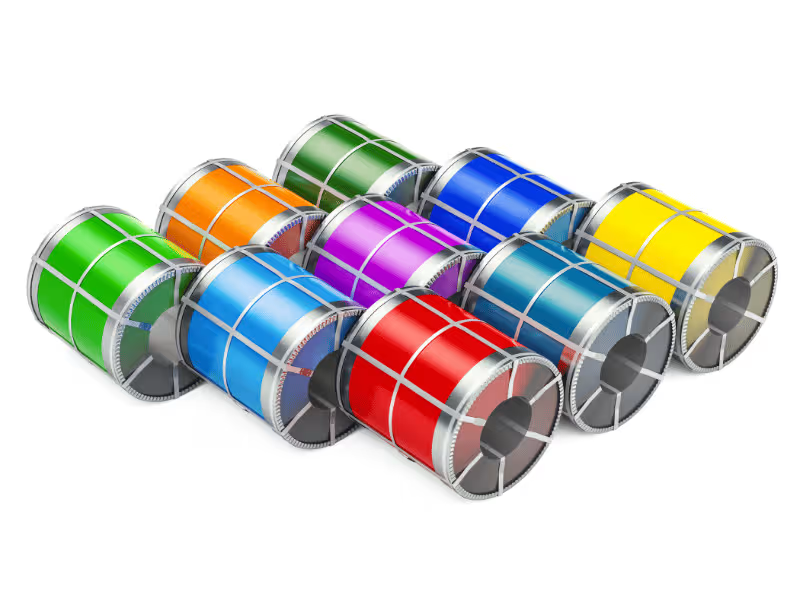
A prepainted steel coil can look perfect on the day it arrives and still fail early. Roof panels start chalking after three summers. Appliance panels crack at the bend. A second shipment comes in a shade lighter than the first. Most of these problems don’t come from bad luck. They come from gaps in the purchase specification.
This guide covers the 10 factors that matter most when buying prepainted steel (PPGI, PPGL, and related products). It is written for procurement managers, engineers, and buyers in construction, manufacturing, and appliances. Here’s the short version:
- Match the coating system to the real service environment, not to the lowest price per ton.
- Specify the substrate, coating mass, and paint thickness in numbers, not general terms.
- Ask for test data such as T-bend, salt spray, and color difference, and confirm how it was measured.
- Account for MOQ, lead time, and batch planning early, especially for custom colors.
Each section explains what to check, what to compare, and where buyers most often go wrong.
1. Corrosion Resistance: Start With the Service Environment
Every other choice depends on where the steel will be used. A wall panel in a dry inland warehouse faces very different conditions than a roof sheet 500 meters from the coast. The same is true of a refrigerator side panel, which sits indoors its whole life.
Start by classifying the environment. Many buyers use the ISO 9223 corrosivity categories, which run from C1 (very low, such as heated indoor spaces) to C5 and CX (very high, such as coastal or heavy industrial zones). EN 10169 adds corrosion resistance classes (RC1 to RC5) and UV resistance classes (RUV1 to RUV4) for organic coated steel. Together, these give you a shared language with your supplier.
What to check:
- Salt spray hours (ASTM B117 or ISO 9227). Standard polyester systems often reach around 500 hours. Higher-performance systems on Galvalume substrates may exceed 1,000 hours.
- UV and weathering data (ASTM G154 QUV or similar). This shows how fast color fades and gloss drops.
- Test conditions. Hours alone mean little unless you know the substrate, coating thickness, and how the panel was scribed and rated.
Risk warning: Salt spray testing is an accelerated comparison tool, not a lifespan prediction. A coil rated for 1,000 hours does not last a set number of years in the field. Use salt spray results to compare suppliers on equal terms, then rely on substrate and paint system choice for real durability.
Common mistake: Buying “general purpose” prepainted steel for a coastal or chemical-exposure project to save cost. The cost of early replacement and warranty claims almost always exceeds the price difference.
2. Base Metal Substrate: GI, GL, ZM, or Cold Rolled
The paint gets the attention, but the metallic coating underneath does much of the corrosion protection. When the paint gets scratched or cut, the substrate decides what happens next.
|
Substrate |
Metallic Coating |
Strengths |
Typical Uses |
Watch Out For |
|---|---|---|---|---|
|
Hot-dip galvanized (PPGI) |
Zinc |
Strong cut-edge protection, good formability, widely available |
General building panels, appliances, interior and moderate outdoor use |
Faster zinc loss in aggressive outdoor environments |
|
Galvalume (PPGL) |
55% Al–Zn |
Excellent barrier protection, heat reflectivity, longer outdoor life |
Roofing, wall cladding, industrial buildings |
Weaker cut-edge protection than zinc, not ideal in contact with wet concrete or certain alkaline conditions |
|
Zinc-magnesium-aluminum (ZM) |
Zn–Al–Mg |
Very good cut-edge and scratch protection at lower coating mass |
Agricultural buildings, coastal projects, demanding structural parts |
Higher cost, more limited supply for some sizes |
|
Cold rolled |
None |
Smooth surface, low cost |
Indoor appliances, furniture, cabinets |
No metallic protection, indoor only |
Coating mass matters as much as coating type. Zinc coatings are written as Z80, Z120, Z180, Z275 (grams per square meter, total of both sides) under EN standards, or G30, G60, G90 under ASTM A653. Galvalume uses AZ100, AZ150, or AZ50/AZ55 under ASTM A792.
A practical rule: indoor appliance parts often use Z40–Z80 or cold rolled steel. Outdoor roofing and cladding usually call for Z180–Z275 or AZ100–AZ150, depending on climate.
Common mistake: Writing “galvanized” on a purchase order without a coating mass. That leaves the supplier free to ship Z40, which is fine for a cabinet and poor for a roof.
3. Paint System and Coating Thickness
The paint system controls weather resistance, color retention, flexibility, and price. Prepainted steel typically has a layered structure: pretreatment, primer, topcoat, and a backcoat on the reverse side. A common front-side build is about 5 µm of primer plus 15–20 µm of topcoat, often written as “20/5” or “15/5.”
Comparing Common Topcoat Systems
|
Paint System |
Relative Durability |
Color and Gloss Retention |
Flexibility |
Best Fit |
|---|---|---|---|---|
|
Polyester (PE) |
Moderate |
Fair |
Good |
Interior panels, appliances, moderate outdoor use |
|
Silicone-modified polyester (SMP) |
Good |
Good |
Moderate |
Roofing and walls where heat and UV are higher |
|
High-durability polyester (HDP) |
Very good |
Very good |
Good |
Long-life outdoor cladding at mid-range cost |
|
PVDF (fluorocarbon) |
Excellent |
Excellent |
Good |
Architectural facades, coastal and high-UV regions |
|
Plastisol (PVC) |
Very good in abrasion and corrosion |
Moderate UV performance |
Excellent |
Heavy-duty cladding, agricultural buildings |
What to Specify
- Topcoat chemistry and thickness in microns, with a tolerance (for example, 20 µm ±2 µm).
- Primer type, such as epoxy or polyurethane. Polyurethane primers often perform better in demanding outdoor conditions.
- Backcoat thickness. A 5–7 µm backcoat is common, but it may be too thin if the reverse side faces humidity or condensation. Some projects specify a two-coat back side.
Risk warning: Thin backcoats are one of the most overlooked causes of failure in roofing. Condensation forms on the underside of roof panels, and a minimal backcoat can corrode from the inside out.
At jyeverest, when buyers send an inquiry with only a color code and thickness, our team asks about the end use first. A RAL 9002 coil for an indoor freezer panel and a RAL 9002 coil for a tropical warehouse roof should not share the same paint system.
4. Yield Strength and Mechanical Properties
The steel needs to survive your forming process and then perform in service. Too soft, and roof panels dent or span poorly. Too hard, and the steel cracks during roll forming or deep bending.
Key mechanical grades to know:
- EN 10346: DX51D (commercial forming), DX52D and DX53D (better drawing), and structural grades such as S250GD, S280GD, S350GD, and S550GD.
- ASTM A653 / A792: CS (commercial steel), FS (forming steel), DS (drawing steel), and SS (structural steel) grades such as Grade 33, 37, 40, 50, and 80.
- JIS G3312 and G3322: Common grades include CGCC and CGLCC for general use.
Match the grade to the job:
- Roll-formed roofing and decking: Higher-strength structural grades (often 280–550 MPa yield) let you use thinner gauges while keeping load capacity.
- Appliance panels with tight bends: Softer forming or drawing grades reduce cracking risk and springback.
- Sandwich panels and general cladding: DX51D or S250GD–S280GD often strikes the right balance.
What to request: yield strength, tensile strength, and elongation values on the mill test certificate, and confirm they match the grade you ordered.
Common mistake: Choosing a high-strength grade for a part with tight radius bends. Full-hard grades like S550GD or Grade 80 offer strength but limited elongation, so they can crack at the bend even when the paint itself is flexible.
5. Surface Finish and Paint Adhesion
Good paint on a poorly prepared surface will still peel. Adhesion depends on cleaning, pretreatment, primer quality, and curing. You can’t see these steps on the finished coil, so you have to rely on test results.
Tests That Tell You Something Useful
- T-bend test: The panel is bent 180° around itself. Results range from 0T (bent flat on itself with no cracking) to 3T or higher. Lower is better. Appliance and deep-forming parts often need 0T–1T; roofing typically accepts 2T–3T.
- Reverse impact test: Measures whether paint cracks or lifts after a sudden impact. Ask for the energy level used, since results mean little without it.
- Cross-hatch adhesion (ISO 2409 or ASTM D3359): A grid is cut into the coating and taped. Flaking indicates weak bonding.
- MEK double rubs: Checks cure level. Under-cured paint fails early in service. Many specifications call for 100 or more double rubs for polyester systems.
- Pencil hardness: Indicates scratch resistance during handling and installation. H to 2H is a common range.
Surface Finish Options
Beyond gloss level (measured at 60° in gloss units), buyers can choose matte, wrinkle, textured, printed wood grain, or stone patterns. Each finish affects how scratches show and how panels look under strong light.
Evaluation tip: Ask for test results from the actual production batch, not a generic data sheet. A product brochure describes what a paint line can do. A batch report shows what it did with your coil.

6. Color Consistency and Batch Stability
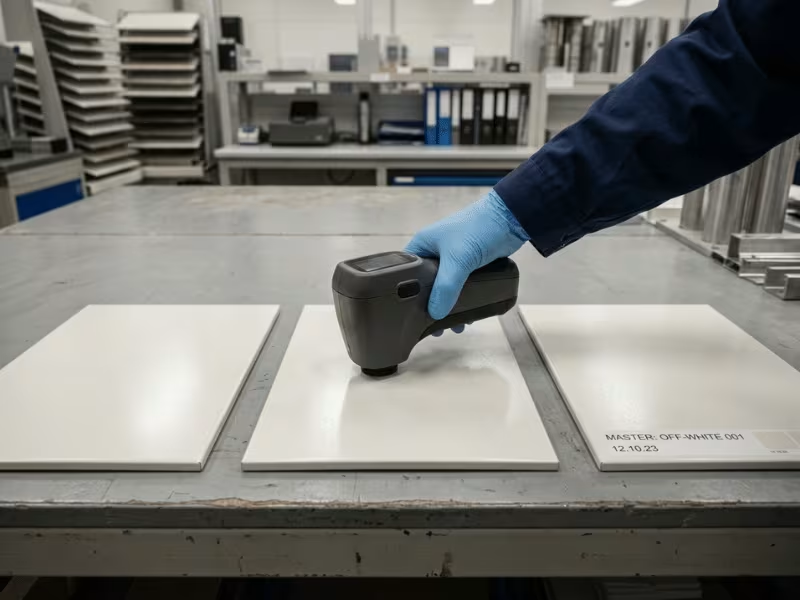
Color mismatch is one of the most visible and frustrating problems in prepainted steel. Two coils that look identical in the warehouse can look clearly different side by side on a building facade or an appliance assembly line.
How color difference is measured: Suppliers use a spectrophotometer to calculate ΔE (delta E), the numeric difference between a sample and the standard. A ΔE of 1.0 or below is generally hard to see for most observers. Many buyers specify ΔE ≤ 1.0 within a batch and ΔE ≤ 1.5 between batches, with tighter limits for premium architectural work.
What affects consistency:
- Paint supplier changes or new paint lots
- Coating thickness variation across the strip width
- Curing temperature differences
- Gloss variation, which changes how color is perceived
How to protect yourself:
- Approve a physical color standard (master panel), not just a RAL or Pantone code. Codes describe a target, not a production-ready match.
- Ask the supplier to record ΔE and gloss for each coil.
- For large projects, order the full color quantity in one production run where possible.
- Keep retained samples from each batch for future matching.
Risk warning: Splitting a single facade or product line across multiple suppliers almost guarantees visible color variation, even when every supplier claims to match the same RAL code.
7. Dimensional Tolerances: Thickness, Width, and Flatness
Small dimensional errors create big problems on a roll forming line or a stamping press. Panels don’t interlock, edges wave, and scrap rates climb.
The Thickness Trap: BMT vs. TCT
This is one of the most common sources of disputes. Thickness can be stated in two ways:
- BMT (Base Metal Thickness): steel only, before metallic and paint coatings.
- TCT (Total Coated Thickness): steel plus zinc or Al-Zn coating plus paint.
A “0.50 mm” coil quoted as TCT may have a base metal of only around 0.45 mm. That difference reduces strength and changes the real price per square meter. Always state which measurement your order refers to.
What to Specify
- Thickness tolerance: often ±0.02 to ±0.05 mm depending on gauge and standard
- Width tolerance: typically 0 to +2 mm or ±1 to ±3 mm, depending on mill edge vs. slit edge
- Flatness and camber limits: critical for long panels and precision parts
- Coil inner diameter: usually 508 mm or 610 mm, matched to your decoiler
- Coil weight range: for example, 3–6 tons, based on your crane and line capacity
Common mistake: Accepting “standard tolerance” without asking which standard. EN, ASTM, and JIS tolerances differ, and some suppliers use their own internal limits.
Pricing note: Since prepainted steel is often sold by weight but used by area, a thinner-than-specified coil can mean you pay for fewer square meters than expected. Check actual yield (m² per ton) against your calculations.
8. Compliance With International Standards
Standards give you a clear, enforceable definition of quality. Without them, “good quality” means whatever the supplier decides.
Key standards for prepainted steel:
|
Region / System |
Substrate Standard |
Prepainted Standard |
|---|---|---|
|
Europe (EN) |
EN 10346 (metallic coated steel) |
EN 10169 (organic coated flat products) |
|
United States (ASTM) |
ASTM A653 (zinc), ASTM A792 (Al-Zn) |
ASTM A755 (prepainted metallic coated steel) |
|
Japan (JIS) |
JIS G3302 (zinc), JIS G3321 (Al-Zn) |
JIS G3312 (prepainted zinc), JIS G3322 (prepainted Al-Zn) |
|
Australia |
AS 1397 |
AS/NZS 2728 |
What to do with this information:
- Name the standard and grade on your purchase order, such as “EN 10169 / EN 10346 DX51D+Z120” or “ASTM A755 / A792 AZ50 SS Grade 50.”
- Make sure the standard fits your destination market and local building codes.
- Avoid mixing standards in a single spec (for example, an ASTM grade with EN coating designations) unless the supplier confirms equivalence in writing.
Common mistake: Assuming “meets international standards” means anything specific. Ask which standard, which grade, and which clauses are covered by the test report.
jyeverest works with buyers across different export markets, so our team regularly helps clients translate a project requirement into the correct standard designation before production starts. Getting this right on paper prevents most disputes later.
9. Supplier Quality Certification and Documentation
A strong specification only works if the supplier can prove compliance. Certification and documentation show whether a supplier runs a controlled process or just hopes for the best.
Checklist for Evaluating a Supplier
- ISO 9001 quality management certification, with a current, verifiable certificate
- ISO 14001 or similar environmental certification, increasingly required by large buyers
- Mill test certificates (MTC) to EN 10204 3.1, linked to coil numbers
- In-house testing capability for T-bend, impact, MEK, gloss, ΔE, and coating thickness
- Traceability from the coil label back to substrate source, paint batch, and production date
- Openness to third-party inspection by agencies such as SGS, BV, or Intertek
- Clear claims process that defines how defects are reported and resolved
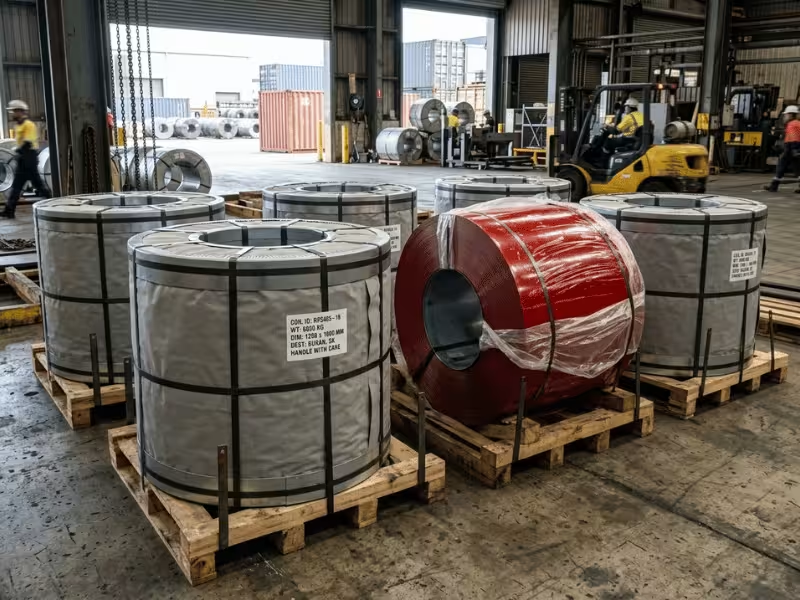
- Export packaging standards: waterproof wrapping, steel edge protectors, and wooden or steel pallets suitable for sea freight
Risk warning: A certificate on a website is not the same as a controlled process. Ask for sample MTCs from recent shipments and check whether the test values are realistic. Identical values across many coils can be a red flag.
Packaging deserves attention. Prepainted coils can suffer white rust, moisture staining, or scratches during ocean transport. Confirm the packaging method, and ask whether a protective film is applied to the painted surface for products that will be formed or handled heavily.
10. Lead Time, MOQ, and Order Planning
Even the right product fails your project if it arrives late or in the wrong quantity. Commercial terms deserve the same attention as technical specs.
Minimum Order Quantity (MOQ)
- Standard colors and sizes often have lower MOQs because suppliers can combine orders on the paint line.
- Custom colors usually need a larger quantity per color, commonly around 20–25 tons, because changing paint on a coating line creates waste and setup time.
- Special substrates or thick coatings (such as ZM or PVDF) may have higher MOQs or longer sourcing times.
Lead Time
Typical production lead times range from about 25 to 45 days after order confirmation, depending on the specification, substrate availability, and line schedule. Add shipping time and customs clearance for international orders.
Planning Tips
- Confirm color approval before the order is finalized. Delays in approving the master panel push back production.
- Order full project quantities in one run whenever color matching matters.
- Build in a buffer of 5–10% for scrap and future repairs, especially for custom colors that are hard to reorder in small amounts.
- Clarify Incoterms (FOB, CIF, DAP) so everyone knows who covers freight, insurance, and risk at each stage.
- Ask about mixed loading. Some suppliers can combine several colors or thicknesses in one container to help you meet MOQ.
Common mistake: Ordering the minimum quantity for the first phase of a multi-phase project, then reordering months later. The second batch may come from a different paint lot and show a visible color shift.
Quick Reference: Prepainted Steel Buying Checklist
Before you send your next RFQ, confirm that it includes:
- Service environment and corrosivity category
- Substrate type and coating mass (e.g., Z275, AZ150)
- Paint system, topcoat and primer thickness, and backcoat specification
- Steel grade with yield strength requirements
- Required adhesion and flexibility tests (T-bend, impact, MEK)
- Color standard, ΔE limit, and gloss range
- Thickness basis (BMT or TCT) with tolerances, width, coil ID, and coil weight
- Applicable standard (EN, ASTM, JIS, or AS)
- Required documentation and inspection rights
- Quantity, delivery date, Incoterms, and packaging requirements
A complete RFQ also makes quotes easier to compare. When every supplier quotes against the same numbers, price differences start to reflect real value instead of hidden specification gaps.
Making a Confident Purchase Decision
Buying prepainted steel well comes down to precision. Define the environment, then lock in the substrate, coating mass, paint system, and mechanical grade that fit it. Back those choices with measurable tests, clear tolerances, and a named standard. Finally, choose a supplier who can document everything and deliver on a realistic schedule.
The cheapest coil per ton rarely turns out to be the cheapest over the life of a building or product line. The right specification protects your budget, your schedule, and your reputation with your own customers.
If you’re preparing a specification or comparing quotes, the jyeverest team is happy to review your requirements. Share your application, target market, and quantities. We’ll help you confirm the right substrate, coating system, and standard before production begins.
