




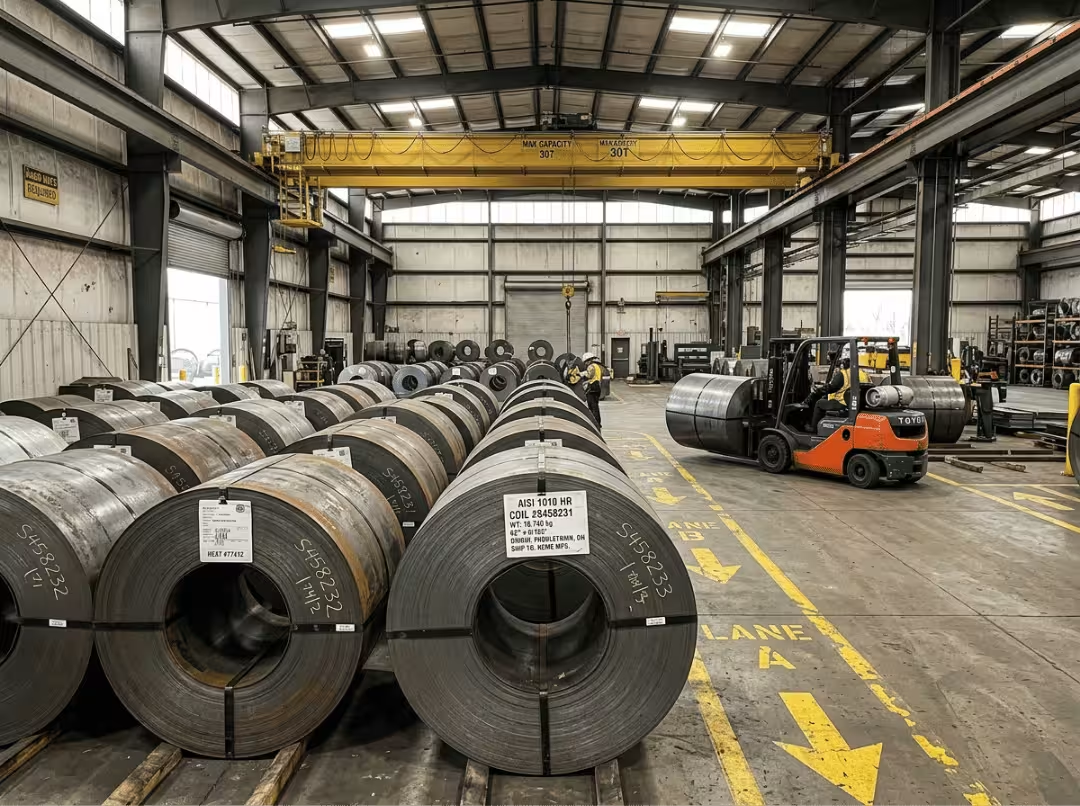
A buyer in Nigeria once ordered 80 tons of galvanized coil. Standard order, clean documentation, coils packed correctly. Then the shipping line rejected three containers at the port. Each one was 2.3 tons overweight. The mistake cost him thousands in repacking fees and a two-week delay, all because the coil weights were estimated instead of calculated.
That’s the trap. Weight looks like a detail until it decides your freight bill, your crane selection, and whether the truck can legally leave the yard. Get it wrong and the problem shows up at the worst possible moment: at the dock, under a crane, or at a port scale.
Here’s the short answer before we go deeper. Most industrial steel coils weigh between 3 and 28 tons, depending on the product type. But that range hides a lot of variation, and “roughly” isn’t good enough when a port limit or a crane rating sits between you and a smooth delivery. This guide walks the full picture: how to calculate coil weight, what changes it, and how to plan around real logistics limits.
Why Coil Weight Drives Every Downstream Decision
Coil weight isn’t a single fixed number for a given “coil.” It shifts with dimensions, steel grade, and coating. And because steel is priced and shipped by weight, that number touches almost everything:
- Freight cost. Ocean freight for steel is charged by weight, not volume. Steel is too dense to fill a container by space, so weight is what you pay for.
- Container planning. Overweight containers get rejected at the port. Underweight ones waste money you already spent on the slot.
- Handling equipment. Your crane, forklift, or coil grab has a rated capacity. Exceed it and you’re risking equipment and people.
- Floor loading. A 20-ton coil resting on a narrow footprint concentrates enormous pressure on a warehouse floor that has to be built for it.
- Budget accuracy. Steel is quoted per ton. A weight error is a budget error, multiplied across every coil in the order.
The buyers who avoid problems all share one habit: they calculate first, then verify against the mill certificate. Estimating is where the money leaks out.
The Quick Reference: Typical Weights by Coil Type
If you just need planning numbers, start here. These are realistic ranges for standard export and industrial coils.
|
Coil Type |
Typical Weight Range |
Common Uses |
|---|---|---|
|
PPGI / PPGL (color-coated) |
3 – 8 tons |
Roofing, wall panels, appliances |
|
Galvanized (GI / GL) |
5 – 15 tons |
Construction, ducts, automotive |
|
Cold-Rolled (CRC) |
5 – 20 tons |
Appliances, furniture, auto parts |
|
Hot-Rolled (HRC) |
10 – 28 tons |
Structural steel, heavy industry |
|
Stainless Steel |
3 – 12 tons |
Kitchen, chemical, architectural |
|
Slit / mini coils |
From 500 kg |
Small workshops, distributors |
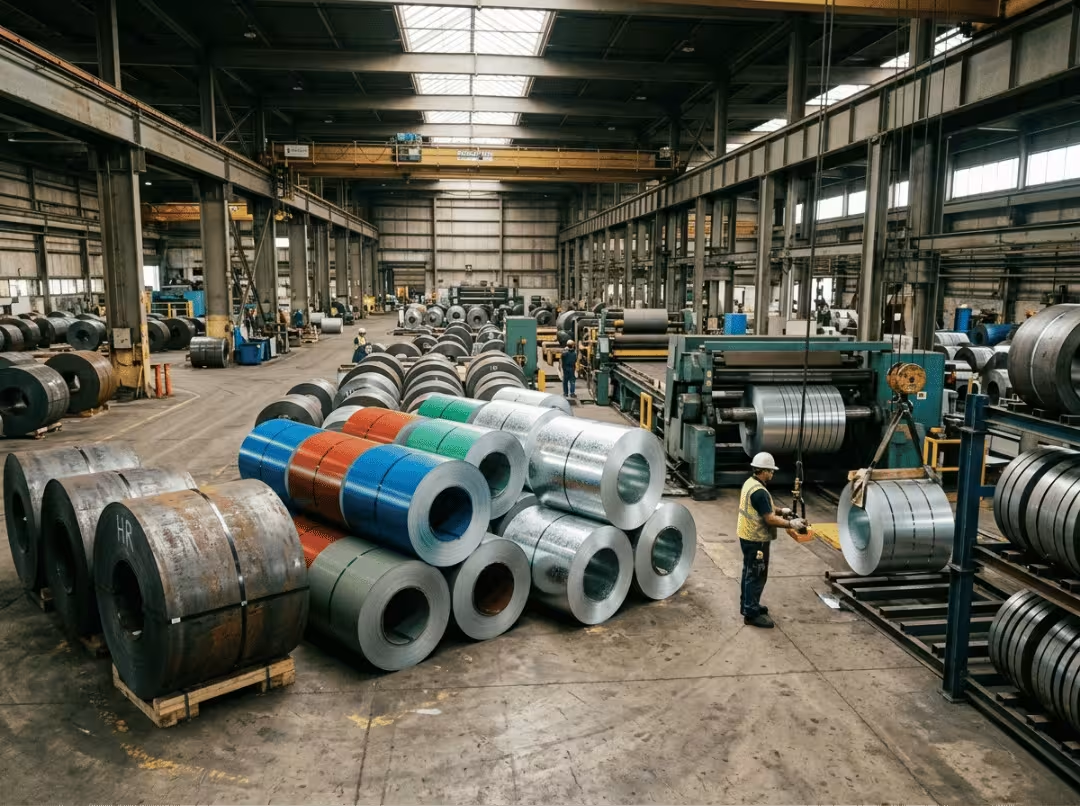
Two patterns explain most of this. Hot-rolled coils run heaviest because they carry thick gauges and wide widths for structural work. Coated products like PPGI stay lighter because coating lines cap coil size and the gauges are thin. Everything else falls in between.
How to Calculate Steel Coil Weight
There are two reliable formulas. Both give the same answer; you pick the one that matches the numbers you actually have.
Method 1: Outer and Inner Diameter
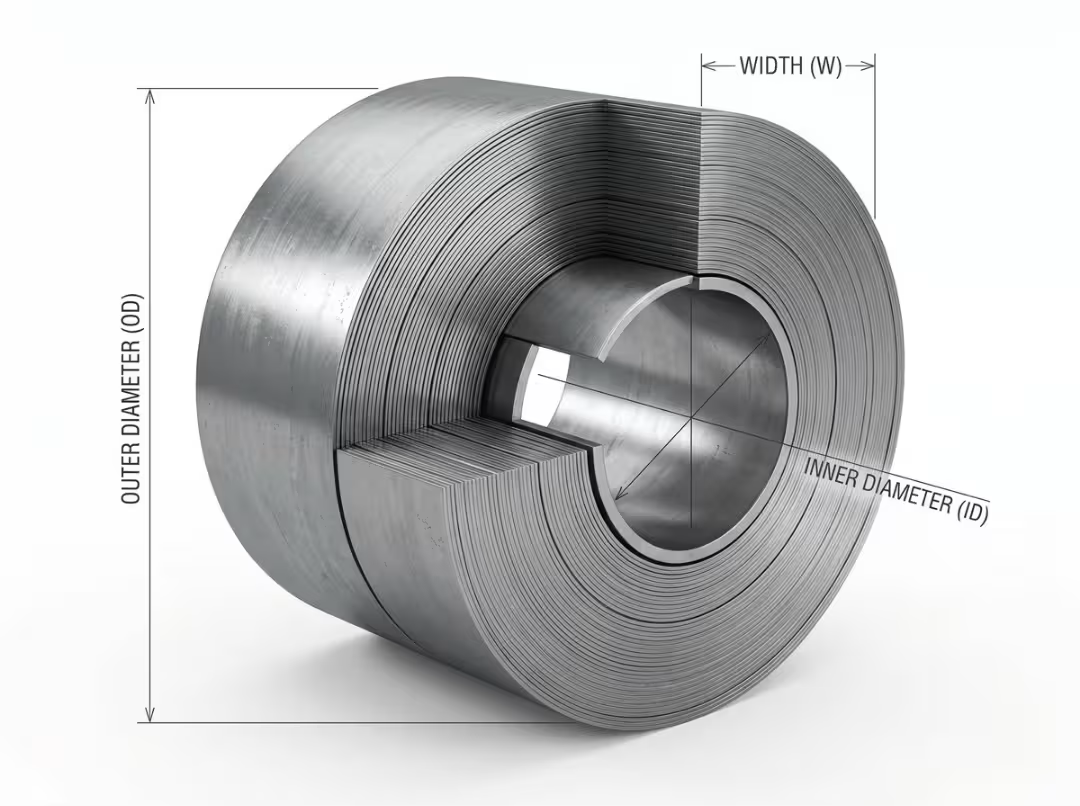
Use this when you know the coil’s physical dimensions but not the strip length. A coil is a hollow ring, so you calculate the ring’s cross-section and multiply by width and density.
Weight (kg) = π × (OD² − ID²) ÷ 4 × W × ρ ÷ 1,000,000
Where OD is outer diameter (mm), ID is inner diameter (mm), W is width (mm), and ρ is density (g/cm³).
Worked example — a color-coated roofing coil:
- Outer diameter: 1,200 mm
- Inner diameter: 508 mm (standard core)
- Width: 1,250 mm
- Density: 7.85 g/cm³
Step 1 — cross-sectional area:
π × (1,200² − 508²) ÷ 4 = π × (1,440,000 − 258,064) ÷ 4 ≈ 928,510 mm²
Step 2 — volume:
928,510 × 1,250 ≈ 1,160,637,500 mm³
Step 3 — weight:
1,160,637,500 × 7.85 ÷ 1,000,000,000 ≈ 9.1 tons
Method 2: Thickness × Width × Length
Use this when you know the strip’s gauge and running length. It’s the cleaner formula for production planning.
Weight (kg) = T × W × L × ρ ÷ 1,000,000
Where T is thickness (mm), W is width (mm), L is length (m), and ρ is density (g/cm³).
Worked example — a cold-rolled appliance coil:
- Thickness: 0.5 mm
- Width: 1,219 mm
- Length: 3,000 m
0.5 × 1,219 × 3,000 × 7.85 ÷ 1,000 = 14,354 kg ≈ 14.4 tons
The Three Mistakes That Wreck the Math
- Treating the coil as solid. A coil is a ring. Forget the hollow center, and you’ll overestimate by 15 to 25 percent.
- Using the wrong density. Carbon and galvanized steel have a density of 7.85 g/cm³. Stainless 304 is 7.93. Small per coil, but it stacks up across a full order.
- Mixing units. Keep everything in millimeters or everything in meters. Never blend them mid-calculation.
Remember that any formula gives a theoretical weight. It’s an excellent estimate for quoting and planning, but the scale weight on the mill certificate is the number that settles the invoice.
The Variables That Change the Weight
Two coils with the same outer diameter can weigh noticeably different amounts. Here’s why.
Density by Material
The formula stays the same; only ρ changes.
|
Material |
Density (g/cm³) |
Note |
|---|---|---|
|
Carbon steel (CRC, HRC) |
7.85 |
Default for most work |
|
Galvanized (GI, GL) |
7.85 |
Coating adds a small amount |
|
Stainless 304 |
7.93 |
Slightly heavier |
|
Stainless 430 |
7.70 |
Ferritic, lighter |
|
Aluminum |
2.70 |
Roughly a third of steel |
Thickness Tolerance
Nominal gauge isn’t the exact gauge. A “0.50 mm” coil can legally run anywhere from about 0.48 to 0.52 mm, and that variation flows straight into weight.
|
Nominal Thickness |
Typical Tolerance |
Weight Swing |
|---|---|---|
|
0.30 – 0.50 mm |
±0.04 mm |
±8–13% |
|
0.50 – 1.00 mm |
±0.05 mm |
±5–10% |
|
1.00 – 2.00 mm |
±0.08 mm |
±4–8% |
|
2.00 – 3.00 mm |
±0.10 mm |
±3–5% |
This matters commercially. Reputable mills run on the plus side of tolerance, so you get roughly what you pay for. Budget mills often run negative: you buy 0.50 mm and receive 0.47 mm, which quietly shorts you on material.
Coating Weight
Zinc and aluminum-zinc layers add real, if modest, weight. For most estimates, it’s minor, but on large orders it’s worth knowing:
- Z100: adds ~1.3%
- Z180: adds ~2.3%
- Z275: adds ~3.5%
- AZ150: adds ~2.0%
If you’re deciding between coating classes, our guide to galvanized steel coil options explains how coating weight affects corrosion protection and cost.
Inner Diameter (Core Size)
The core has to match your decoiler mandrel, and it also affects how much material sits on the coil. Three standards cover most products:
- 508 mm (20″): thin-gauge and coated products
- 610 mm (24″): thicker cold-rolled
- 762 mm (30″): hot-rolled and heavy gauge
Logistics: Where Weight Becomes Money
This is the section that prevents rejected containers and stalled cranes.
Container Payload Limits Vary by Route
A 20′ container’s structural limit is around 28 tons, but that number rarely applies. Ports and road authorities set lower practical limits, and they enforce them:
|
Route |
Practical Limit per Container |
|---|---|
|
China ports |
24 – 26 tons |
|
European roads |
21 – 24 tons |
|
US trucking |
19 – 21 tons (strict) |
|
African ports |
20 – 22 tons |
Always confirm the limit for your specific destination before loading. The Nigeria story at the top happened because the coils were planned to a general limit, not the actual port limit.
Loading Orientation
- Eye-to-sky (vertical): the coil stands upright. Distributes weight well and suits heavy coils, but often needs floor reinforcement.
- Eye-to-side (horizontal): the coil lies on its side in a cradle. Common for smaller coils, letting you fit more in a 40′ container. Requires wooden or steel cradles to stop rolling.
Whichever you choose, distribute coils evenly across the floor. Front-heavy or rear-heavy loading triggers axle-overload violations at port inspection, even when the total weight is legal.
Match Weight to Handling Equipment
A crane rated for 10 tons cannot safely lift a 12-ton coil. Check capacity before you order, not after the truck arrives.
|
Equipment |
Typical Capacity |
Safe Coil Weight |
|---|---|---|
|
Standard forklift |
2.5 – 5 tons |
Up to 4 tons |
|
Heavy forklift |
8 – 16 tons |
Up to 14 tons |
|
Overhead crane |
10 – 30 tons |
Up to 25 tons |
|
Coil car/buggy |
20 – 50 tons |
Heavy mill coils |
Practical Tips for Buyers
A few habits separate smooth orders from costly ones.
Always verify the mill certificate scale weight. Every reputable supplier provides a weight certificate showing gross, net, and tare weight. Theoretical weight is your planning number; the certified scale weight is what you should invoice and ship against. If actual weight deviates more than about ±3% from your calculation, ask questions.
Specify weight limits when you order. Tell the supplier three things:
- Maximum weight per coil, based on your crane or forklift
- Minimum weight per coil, so you don’t drown in small remnants
- A target range, so the supplier can optimize container loading
For color-coated projects, you can request coil weights tailored to your route directly through the color-coated steel coil range, helping avoid the overweight-container problem before it starts.
Convert weight to linear meters when bidding. Steel is priced per ton but consumed per meter, so for roofing or cladding jobs you need to know how many meters a coil actually gives you:
Length (m) = Weight (kg) ÷ (T × W × 7.85 ÷ 1,000)
Example: a 5-ton coil at 0.5 mm × 1,000 mm yields
5,000 ÷ 3.925 ≈ 1,274 meters.
If you’re weighing coating classes against coverage and durability for a specific build, the PPGI vs PPGL comparison breaks down how each choice affects both weight and performance.
Frequently Asked Questions
What is the average weight of a steel coil?
There’s no single average, because it depends on the product. Hot-rolled coils typically run 10–28 tons, cold-rolled 5–20 tons, galvanized 5–15 tons, and color-coated (PPGI) 3–8 tons. Most common export coils land somewhere between 5 and 10 tons.
How do I calculate the weight of a steel coil from its dimensions?
Use Weight (kg) = π × (OD² − ID²) ÷ 4 × W × ρ ÷ 1,000,000 when you know the diameters, or T × W × L × ρ ÷ 1,000,000 when you know thickness and length. Keep all dimensions in millimeters (or meters for length), and use 7.85 g/cm³ for carbon and galvanized steel.
What is the difference between theoretical weight and actual scale weight?
Theoretical weight is calculated using the formula and assumes exact dimensions. Actual scale weight is measured on a certified scale after production and reflects real thickness tolerance, coating, and winding. Theoretical weight is fine for quoting and planning, but the scale weight on the mill certificate is what you should invoice and ship against. A gap within ±3% is normal.
How many steel coils fit in a 20-foot container?
Usually 2 to 4 coils, limited by weight rather than space. The practical payload for a 20′ container is roughly 20–24 tons depending on the route. That’s four 5-ton coils or two 10-ton coils. Always confirm your destination port’s limit before loading.
What is the weight tolerance for steel coils?
It depends on how the steel is sold. When sold by actual weight (the most common basis), the scale ticket is final, and you pay for exactly what you receive. When sold by theoretical weight, ±3% is standard. Clarify the pricing basis before you place the order so there are no surprises on the invoice.
Putting the Numbers to Work
Coil weight depends on four inputs: density, outer diameter, inner diameter, and width. Plug them into the formula, and you get a solid estimate for quoting, container planning, and equipment matching. That estimate covers most of your planning needs.
But the number that actually governs your shipping, lifting, and invoicing is the scale weight on the mill certificate. Treat the formula as your forecast and the certificate as your source of truth.
Here’s the one habit that prevents most weight problems at the dock: calculate the theoretical weight for your next order, then verify it against the certified scale weight before the truck arrives. Do that consistently, and overweight containers, mismatched cranes, and budget surprises stop happening.
